
A Marketing Instructor's Guide to Building a Successful Brand
Whether you're launching a new business or struggling to gain traction with an existing one, this article is for you.
Throughout my career, I’ve helped students, entrepreneurs, and professionals understand what actually makes brands succeed; Not theory, but real, foundational marketing principles. From that experience, I developed a practical framework for building and optimizing a brand using simple, powerful fundamentals. You don’t need an MBA to apply these ideas. Once you understand them, they stick and drive outcomes.
Getting Started
Before we jump in, you should familiarize yourself with these key ideas:
In the business world, there's a concept called a marketing mix. A marketing mix is a foundational strategy that businesses build to introduce their products and/or services to their market (target audience). Each business has its own unique marketing mix based on its marketing concept or philosophy (the needs and goals of its business balanced with customers' shifting needs, preferences, and perception of value).
The marketing mix is built with 4 primary factors in mind. These 4 factors are known as the 4 Ps of Marketing:
Product: What product(s) and/or service(s) are you providing your customers? The goal is to clearly define your business's product and/or service offering.
Price: What price are you offering the product(s) and/or service(s) at? The goal is to optimize perceived value for the customer while ensuring a solid profit margin for your business.
Place: Where are you going to sell/offer your product(s) and/or service(s)? The goal is to ensure that your customers can purchase and acquire your product(s) and/or service(s) where they expect to find them.
Promotion: How are you going to communicate the existence of your product(s) and/or service(s)? The goal is to ensure that your marketing/target audience is aware that your product exists and understands its potential value to them.
The 4 Ps of Marketing are interrelated. As you make business decisions that impact one factor, the other factors must shift to compensate for that change.
For example, if you lower the price of a product because your sales data reveals customers aren't buying it as broadly as you expect, you could allocate funds to promotion. Releasing a sales promotion advertising the lower price could lead to increased sales of the product in question. This demonstrates how a decision impacting one P (Price) could impact decisions impacting another P (Promotion).
Businesses don’t fail because they ignore marketing. They fail because their marketing mix is misaligned. When one element shifts, the others must adapt or performance suffers.
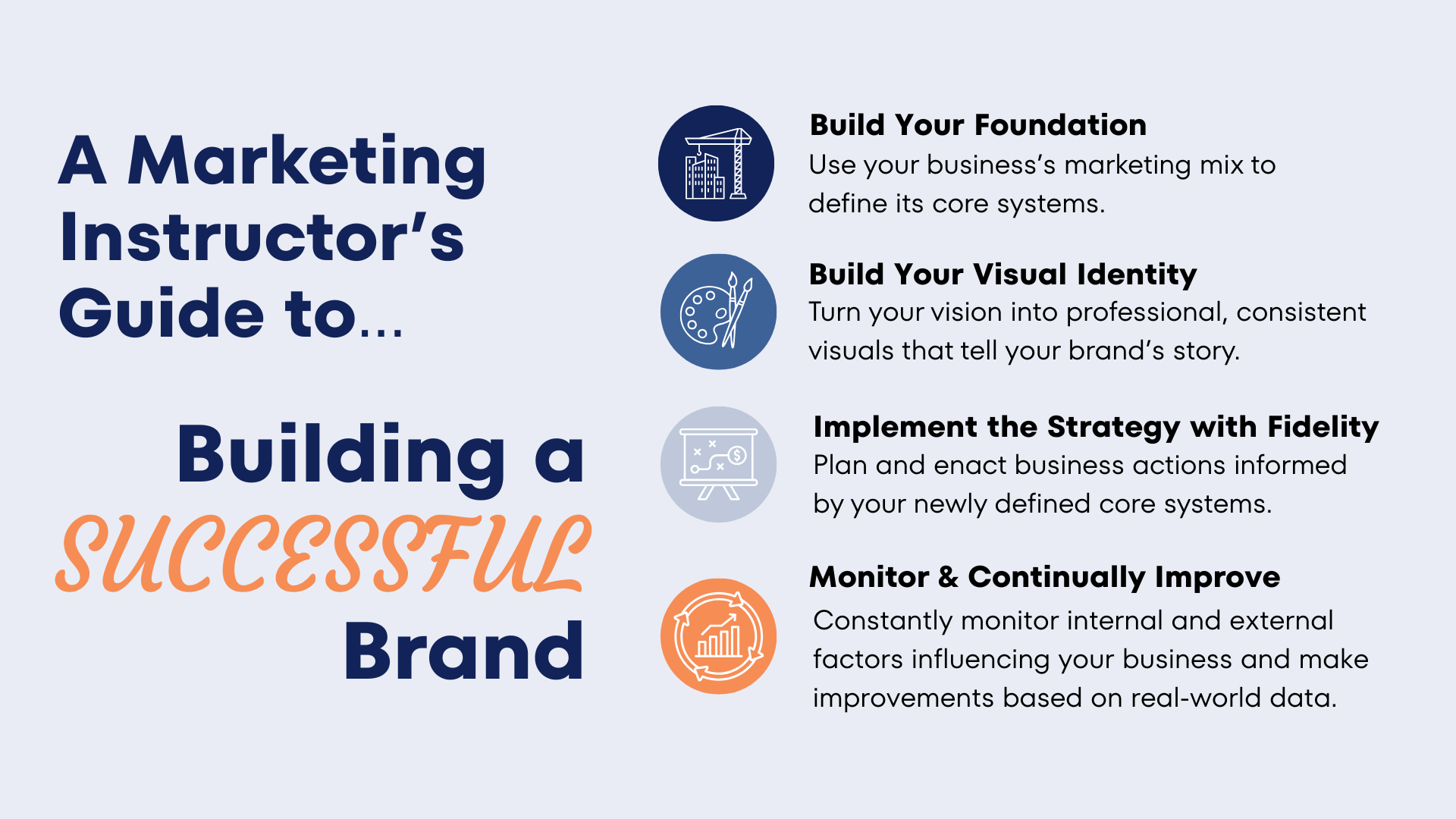
Step 1: Build Your Foundation
Now that you understand the key ideas, it’s time to build your business's foundation. Your brand begins with your marketing mix. These decisions define what your business is, but also what it is not. This foundation will establish your scope, shape your story, and determine how customers will experience the value your business can offer them.
Product
Goal: Clearly define your business's product and/or service offering while ensuring you understand the logistics required to make that vision happen.
Ask yourself:
What product(s) and/or services will I offer?
How will I make the product and/or provide the service?
If selling a product, will I make it myself or acquire it elsewhere and then mark up the price when reselling?
If manufacturing or assembling a product, what will manufacturing and/or assembly look like? Do I need specific equipment or storage conditions?
If offering a service, what supplies and/or equipment do I need to provide the services?
If tangible (physical) items are involved, what quantity will be produced, and where/how will they be stored?
Price
Goal: Optimize value for the customer while ensuring a solid profit margin for your business.
Ask yourself:
What price can I set for this product that will optimally balance customer demand and inventory supplied?
What price is competitive based on the state of the economy, market data, and competitive intelligence?
What price should I set to meet the product's positioning in the market? For example, premium versus value pricing based on the primary market's preferences.
How sensitive is my market/target audience to price fluctuations? If I increase the price, will demand change drastically, or will demand remain the same even when the price is increased?
What is the maximum (max) price my customer will pay without decreasing their demand and perception of value?
What is the minimum price that I can offer the product at and still maintain a specific return on investment and profit margin? What is the cost of goods sold (COGS) or cost of services rendered (COSR) for the product and/or services I offer?
What financial goals do I have for my business, and how does price play into those financial goals? Do I want to be debt-free quicker, or am I fine holding debt if it means I can expand my operation and boost profit in the future (and then pay off debt)?
Place
Goal: Ensure that your customers can purchase and acquire your product(s) and/or service(s) where expected.
Ask yourself:
Where does my market/target audience(s) expect to find the product and/or service?
Would my product(s) and or service(s) be best sold in-person through a traditional brick-and-mortar store, digitally/online through e-commerce, or both?
How will customers go about acquiring the particular product and/or service?
What are the logistics for ensuring the customer receives their product(s) and/or service(s) in a prompt and accessible fashion?
How does manufacturing, inventory storage, and shipping/logistics impact my product(s) and/or service(s)?
Promotion
Goal: Ensure that your marketing/target audience is aware that your product exists and understands its potential value to them.
Ask yourself:
Who is my primary audience and how do they consume information?
How will I advertise my business's products and/or services? Consider options like digital media (i.e., social media advertising, commercials on streaming platforms, engaging websites) or traditional forms of media (i.e., print, newspapers/circulars, billboards, flyers).
Is the advertising method I plan to use consistent with the way my target audience consumes information? These must be aligned.
What is the value proposition of my product(s) and/or service(s)? What makes them special, and how can I communicate that to the customer through storytelling and strategic promotion?
With your strategic foundation in place, you can now shape how your brand is seen and experienced.
Step 2: Build Your Visual Identity
Did you feel like Step 1 was a lot? You should've. Building the foundation for your business is the hardest part. You have to ask yourself hard questions before you have clarity about what your business actually does.
Now that you've figured that out, let's explore the creative side of marketing. Step 2 of building your business's brand is the part where you build a visual identity for your brand. Take the skeleton you built in Step 1 and bring it to life through the use of color, language, rhetoric, and professional media like image and video assets.
Your visual identity should communicate your brand’s personality instantly. Consistency builds recognition, and recognition builds trust. Every visual and linguistic element (from color choice to tone of voice) should reinforce the same message about who you are and the value you provide.
Color Palette
Goal: Establish emotional tone, recognition, and consistency across all brand materials.
Color influences perception more than most businesses realize. Different colors evoke different emotions and expectations. Your color palette should reflect your brand’s personality and positioning in the market.
Ask yourself:
What emotional response do I want customers to feel when they encounter my brand?
Do my colors communicate professionalism, innovation, affordability, luxury, energy, calmness, or reliability?
Are my primary and secondary colors visually distinct yet complementary?
Will these colors remain effective across digital and print environments?
Are my colors consistent across all platforms and materials?
Consistency is key. Customers begin to associate color with identity. Over time, your palette builds a recognition pattern for customers.
Logo(s)
Goal: Create a recognizable and scalable visual mark representing your business.
Your logo is often the first visual customers associate with your brand. It should be simple, memorable, and adaptable across multiple environments.
Ask yourself:
Does my logo clearly reflect my brand’s personality and positioning?
Is my logo simple enough to be easily recognizable at small sizes?
Does it scale well across digital, print, signage, and merchandise?
Do I have variations (full logo, icon, monochrome, horizontal/stacked)?
Will this logo remain effective as my business grows?
Avoid overcomplication. The most effective logos are simple, intentional, and consistent.
Language & Rhetoric
Goal: Define how your brand communicates and speaks to customers.
Your brand voice is just as important as your visual elements. It shapes how customers perceive your professionalism, relatability, and credibility.
Ask yourself:
What tone does my brand use? (Professional, conversational, technical, friendly, authoritative, inspiring, etc.)
Who am I speaking to, and how do they prefer to be communicated with?
Is my messaging clear, consistent, and aligned with my brand identity?
Do my words reinforce my value proposition and positioning?
Does my messaging build trust and confidence in my expertise?
Your voice should remain consistent across all platforms—from website copy to social media to customer interactions.
Image & Video Assets
Goal: Use professional, intentional media to visually communicate your brand’s value and story.
Visual media strengthens perception, credibility, and engagement. Poor or inconsistent visuals weaken brand trust and prevent your brand from telling compelling stories and communicating quality, value, and product and/or service knowledge to customers.
Ask yourself:
Do my images and videos reflect my brand’s quality and professionalism?
Are visuals consistent in tone, color, and messaging?
Do my visuals show my product/service in a compelling and realistic way?
Are visuals optimized for the platforms where they will appear?
Do my visuals tell a story about my brand and the value I provide?
Strong visuals don’t just show what your business does. They communicate why it matters.
Step 3: Implement Your Strategy with Fidelity
Strategy without execution is just intention. Now it’s time to execute your strategy into something that's an actual business and not just a plan or vision.
Once your marketing mix and visual identity are clearly defined, implementation begins. This step transforms planning into action and establishes your business operationally, financially, and legally.
Establish the Business Structure
Goal: Legally and structurally form your business in alignment with your goals.
Choose the appropriate business structure (sole proprietorship, LLC, corporation, etc.)
Register your business according to your state’s requirements
Secure any necessary licenses, permits, or compliance approvals
Establish financial systems (business bank account, accounting, tax planning)
Align Financial Reality with Strategic Vision
Goal: Ensure your strategy is financially sustainable and executable.
Ask yourself:
How much capital do you currently have available?
What startup or operating costs must be covered?
What funding options are available (personal capital, loans, investors, partnerships)?
How does your pricing strategy (defined above) support profitability and cash flow?
What level of risk is acceptable based on your financial goals?
A strong strategy must be grounded in financial reality. Sustainability matters more than speed. Overexpanding (whether that's opening too many locations or scaling a current location too soon) can be financially devastating. Focus on sustainable growth that prioritizes success at the current level before accepting additional financial risk.
Execute with Consistency and Discipline
Goal: Bring your brand and marketing strategy to life consistently across all operations.
Launch your product/service aligned with your marketing mix
Maintain consistency across branding, messaging, and customer experience
Deliver the value your strategy promises
Focus on balancing operational reliability and quality to limit financial risk while still ensuring high-quality products and/or services and superior customer service
Brands are built through consistent execution, not one-time effort.
Step 4: Monitor, Reflect, and Continually Improve Your Marketing Strategy
Strong brands are not static; they evolve. The final step is establishing reflective practices that allow your business to learn, adapt, and improve over time. Sustainable growth depends on your ability to respond to data, customer behavior, and market changes.
Monitor Performance Using Real Data
Goal: Measure what matters and track progress toward business goals.
Are sales increasing, stable, or declining?
Is customer demand meeting expectations?
Are marketing efforts generating measurable results?
Is pricing aligned with perceived value?
Are operations efficient and sustainable?
Use both internal data (sales, costs, customer behavior) and external data (economic and market trends, competition, customer feedback).
Reflect on Goals and Strategic Alignment
Goal: Ensure your business remains aligned with its mission and value proposition.
Are you meeting your original business and financial goals?
Does your marketing mix still align with customer needs and market expectations?
Is your brand perception consistent with your intended positioning?
What is working—and what is not?
Reflection creates clarity and direction for improvement.
Continually Improve Operations and Strategy
Goal: Increase effectiveness, efficiency, and long-term sustainability.
Streamline operations to improve efficiency without sacrificing quality
Adjust pricing, promotion, or positioning based on performance data
Improve customer experience and perceived value
Maintain balance between cost control and brand quality
Stay responsive to market changes and customer expectations
Continuous improvement is a balancing act. Efficiency drives profitability; however, trust, quality, and value sustain long-term growth for your brand.
Primary Takeaway
Building a successful brand isn't about luck, trends, or guesswork. It is about clarity, intentional strategy, disciplined execution, and continuous improvement.
By defining your marketing mix, you establish the strategic foundation of your business. By building a strong visual identity, you shape how customers perceive and remember your brand. Through consistent execution, you transform strategy into real-world results. And by monitoring performance and continually improving, you ensure your business remains aligned with customer needs, market conditions, and long-term goals.
Strong brands aren't built overnight. They're built through consistency, reflection, and the willingness to adapt without losing core identity. Efficiency and profitability matter, but they must never come at the expense of quality, trust, or perceived value.
At its core, business success comes down to one simple truth: customers choose brands they trust and value. When your strategy, operations, and messaging align to consistently deliver meaningful value, growth becomes a natural outcome rather than a forced one.
If you're building a brand, or rebuilding one (it happens), focus on your foundation, stay disciplined, and commit to continual improvement. Results will follow.

Still Stuck? Foundry 27 Can Help
Many businesses struggle not because they lack effort, but because something within their system is misaligned: strategy, positioning, operations, messaging, or execution. When one part of the system breaks down, growth slows or stops entirely.
If you find yourself stuck at any stage of this process, Foundry 27 offers a Systems Assessment designed to identify where breakdowns are occurring and which strategic adjustments will create the greatest impact. This structured evaluation examines your marketing mix, brand positioning, operational alignment, and growth readiness to provide clear, actionable direction.